How Dinosaur Books Help Children Learn Science and Stay Curious
There are few things quite as entertaining as a child who has just discovered dinosaurs.
You might be halfway through explaining something perfectly ordinary when a small voice interrupts with a very important question. Did dinosaurs have feathers? How big was a T. rex's tooth? Could a dinosaur run faster than a car? And, perhaps most importantly, why did the dinosaurs disappear? You answer one question, and three more appear.
If you have ever experienced this kind of conversation, you have already seen something wonderful in action. Children are not simply collecting dinosaur facts. They are trying to understand how the world works. That is what makes dinosaur books so fascinating. They bring together science, imagination, discovery, and the kind of questions that encourage children to look beyond what they already know. A well-chosen dinosaur story can introduce a young reader to scientific ideas without making learning feel like a lesson at school.
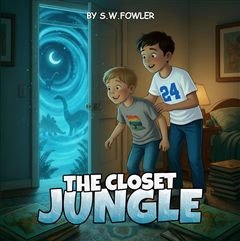
For me, that combination of curiosity and imagination is one of the most exciting things about children's storytelling. It is also part of what makes The Closet Jungle, my dinosaur adventure featuring two brothers, Reid and Josh, so special. When an ordinary closet becomes the doorway to a prehistoric world, familiar surroundings suddenly become an invitation to explore the extraordinary. But what exactly can children learn from dinosaur books, and how can parents use that fascination to encourage scientific thinking?
Let's take a closer look.
1. Dinosaurs Turn Ordinary Questions Into Scientific Discoveries
Children are natural question-askers. They want to know why the moon follows the car, where rain comes from, and whether a tiny ant has a home somewhere nearby. Their questions might seem random to adults, but they often reveal an emerging desire to understand patterns, causes, and relationships. Dinosaurs offer an especially exciting way to encourage this instinct.
Consider the question, "Why were some dinosaurs so big?"
It sounds simple enough, but answering it opens the door to a fascinating discussion about different species, their environments, their diets, and the scientific evidence researchers use to study prehistoric life.
Or take the question, "How do we know what dinosaurs looked like if nobody saw them alive?"
Now we have an opportunity to introduce fossils, bones, footprints, scientific reconstruction, and the difference between what scientists know and what they are still investigating. Suddenly, a dinosaur book has become much more than a collection of pictures. It has become the starting point for a scientific investigation.
The beauty of these conversations is that you do not need to know every answer. In fact, saying "I'm not sure. Let's find out together" can be a wonderful way to show children that learning is an ongoing process. You can look at a book, consult a reliable children's science resource, or explore a museum website together. The important thing is to show children that questions deserve attention and that finding an answer can be an adventure in itself.
And if the next question involves whether a dinosaur could have eaten your sofa, well, that is another investigation entirely.
2. Dinosaur Books Introduce Children to the World of Science
Science can sometimes seem like a collection of complicated words, diagrams, and facts that children are expected to remember. Dinosaur books provide a more approachable starting point because they introduce scientific concepts through creatures children already find exciting. Depending on the book, young readers might encounter ideas from several scientific fields.
- Paleontology: Children discover how scientists study fossils to learn about organisms that lived millions of years ago.
- Biology: They explore differences between animals, including body structures, teeth, movement, and possible adaptations.
- Earth science: They learn that the planet has changed dramatically over time and that continents, climates, and habitats were not always as they are today.
- Ecology: They begin to understand how living things depend on their environments and how food chains connect different organisms.
- Geology: They can discover how rocks form, how fossils become preserved, and why certain layers of rock contain evidence of ancient life.
The best part is that these ideas do not have to be presented as formal lessons. A story about a dinosaur searching for food can lead to a conversation about what different animals eat. An illustration of a prehistoric landscape can inspire questions about climate and habitat. A page showing fossil discoveries can introduce the idea that scientists build explanations from physical evidence. Children do not need to memorize every scientific term immediately. First, they need opportunities to notice, wonder, compare, and ask questions.
A dinosaur book can provide that first spark.
Parents can build on it by asking simple questions: What do you notice about this dinosaur's teeth? What might those teeth tell us about its diet? Which details in the picture are facts, and which might be the illustrator's imagination? These small conversations help children begin to see science as a way of exploring the world, rather than simply a subject they will encounter in a classroom.
3. They Help Children Practice Problem-Solving
A good adventure rarely allows its characters to spend the entire story doing exactly what they expected. Something goes wrong. A clue is missing. A plan fails. A character must decide whether to try another approach.
These moments create opportunities for children to think about problems and possible solutions. Dinosaur stories can provide particularly engaging scenarios. What would an explorer do if a bridge were too damaged to cross? How might a character find a safe route through unfamiliar terrain? What information would help someone identify an unknown dinosaur? The situations do not need to be realistic in every detail. Their value lies in encouraging children to consider a challenge from more than one angle.
You can help by guiding your child through a simple problem-solving process.
- First, identify the problem. What has gone wrong, and what does the character need to achieve?
- Next, consider the available information. What does the character know? What remains uncertain?
- Then, explore possible solutions. Could the character ask for help, gather more information, change direction, or try something different?
- Finally, evaluate the outcome. Did the solution work? What could the character learn from the experience?
For example, if a fictional explorer becomes lost in a prehistoric landscape, children might suggest following a river, looking for familiar landmarks, or returning to the last known safe location. You can discuss the advantages and risks of each suggestion without needing to settle on one perfect answer. This is an important distinction: problem-solving is not always about finding the quickest solution. It is about thinking carefully, considering consequences, and learning from experience.
Stories give children a safe space to explore these decisions before they encounter similar challenges in their own lives.
4. Dinosaurs Make Classification and Comparison Fun
Science often involves observing similarities and differences, grouping things according to shared characteristics, and recognizing patterns.
To adults, classification might sound like a technical exercise. To a dinosaur-loving child, it can feel like an invitation to become an expert. Imagine placing pictures of a Triceratops, a Stegosaurus, and a Brachiosaurus on a table. What do children notice?
They might compare body size, the shapes of their heads, the structures of their backs, or the lengths of their necks. They could group dinosaurs according to features they observe and explain why they placed certain animals together. With guidance, they can also learn that popular groupings do not always reflect scientific classifications. For instance, not every prehistoric reptile was a dinosaur, and animals that lived during the same broad geological era did not necessarily live at the same time.
These distinctions can lead to wonderful questions.
Was a Pteranodon a dinosaur? No, it was a flying reptile, not a dinosaur. Did every dinosaur eat plants? No, different species had different diets. Were all dinosaurs enormous? Certainly not; many were much smaller than the giant creatures that tend to dominate children's imaginations. The more children explore these differences, the more they learn to look beyond appearances and recognize meaningful patterns.
You can make this a hands-on activity by creating simple dinosaur cards. Include a picture, the animal's name, its approximate size, its diet where known, and a few distinguishing features. Ask your child to sort the cards in different ways. They could group dinosaurs by diet, compare their sizes, or identify which features make each one distinctive. There is no need to turn the activity into a test. Let your child explain their choices, ask questions, and discover that there can be several interesting ways to organize information.
That is classification with a little prehistoric excitement.
5. Dinosaur Books Can Turn Reading Into Hands-On Exploration
Sometimes, a book inspires children to do something rather than simply read about it. That is where dinosaur books can become especially useful for families, teachers, and anyone looking for engaging activities that connect reading with science. Here are three easy ways to bring a dinosaur story to life.
Become a fossil detective
Hide small dinosaur pictures or paper footprints around a room or yard. Ask your child to follow the clues and record what they find. Encourage them to describe the evidence before guessing which dinosaur might be nearby.
Build a prehistoric habitat
Using paper, cardboard, blocks, or recycled materials, invite your child to create a landscape for a dinosaur. Discuss what the animal might need to survive, including food, water, shelter, and an appropriate environment.
Design a dinosaur investigation
Choose two dinosaurs and compare their features using a reliable reference book. Ask your child to identify similarities and differences, then explain which facts helped them reach their conclusions. These activities do not require expensive supplies or elaborate preparation. Their purpose is to encourage observation, creativity, and discussion. They also remind children that learning does not have to stop when a book closes. A story can lead to a drawing, a question can lead to an investigation, and an interesting fact can inspire an entire afternoon of discovery.
6. Let Imagination and Scientific Facts Work Together
One final point is worth remembering: children's fiction and scientific accuracy do not have to compete with one another. A dinosaur adventure can contain extraordinary situations, imaginative characters, and exciting surprises while still encouraging children to become interested in real science.
In fact, fiction can make scientific subjects more approachable because it gives readers characters and situations they can connect with emotionally.
That is part of the appeal of The Closet Jungle. Reid and Josh's adventure begins with an imaginative idea: a closet that opens into a prehistoric world. The premise invites young readers to explore an unfamiliar setting alongside characters they can follow and care about. The story is not intended to replace a science textbook. Instead, it offers an imaginative starting point for conversations about dinosaurs, discovery, bravery, and the experience of facing the unknown. After reading an adventure, a parent might explore a nonfiction dinosaur book with their child, look up a real fossil discovery, or discuss which elements of the story are fictional and which connect to scientific knowledge.
This combination allows children to enjoy the freedom of imagination while developing a deeper interest in the real world. And that is a wonderful outcome. We do not have to choose between stories that entertain and experiences that educate. The best reading experiences can do both, each in its own way.
Raising Curious Minds, One Dinosaur at a Time
Dinosaur books offer children much more than enormous teeth, spectacular tails, and creatures that disappeared millions of years ago. They provide opportunities to ask questions, examine evidence, recognize patterns, make predictions, and consider solutions to unfamiliar problems.
More importantly, they can help children develop a habit that serves them throughout life: the willingness to remain curious. You do not need to turn every reading session into a science lesson. Sometimes, a child simply wants to enjoy the adventure, laugh at a surprising moment, or spend ten minutes studying an illustration of a dinosaur's enormous feet.
Let them.
When a question does arise, follow it. When your child makes an interesting observation, ask them to explain their thinking. When they suggest a solution to a fictional problem, explore the possibilities together.
You might discover that the most valuable part of reading is not the fact your child remembers tomorrow. It is the question they ask next. That spirit of discovery lies at the heart of imaginative adventures like The Closet Jungle. Reid and Josh's journey into a prehistoric world reminds young readers that the unfamiliar can be exciting, challenges can be approached with courage, and curiosity can lead somewhere unexpected.
Perhaps your child will finish a dinosaur book wanting to become a paleontologist. Perhaps they will draw their own prehistoric creatures, build an elaborate dinosaur habitat, or spend the next week explaining the difference between a flying reptile and a dinosaur to every willing listener in the house. Whatever happens, you have helped create an opportunity for learning.
So, the next time your child brings you a dinosaur book and announces that they have an extremely important question, make yourself comfortable. You may be about to learn something, too. And if that question turns out to be whether a Stegosaurus could fit through your front door, well, at least you have an excellent reason to start measuring.
Ready to explore a prehistoric adventure? Discover The Closet Jungle by S.W. Fowler, where brothers Reid and Josh step into an imaginative world filled with dinosaurs, surprises, and unexpected challenges. Open the book, follow their journey, and see where curiosity takes you.
Keep reading: Why kids love dinosaurs · How to explain dinosaur extinction to kids · Dinosaur activities for preschoolers
Frequently asked questions
What science can children learn from dinosaur books?
Dinosaur books can introduce paleontology, biology, earth science, ecology and geology: how fossils form, how animals differ, how the planet has changed and how living things depend on their environment.
Do I need to know all the answers to my child’s dinosaur questions?
No. Saying “I’m not sure, let’s find out together” shows that learning is an ongoing process. Look it up in a reliable children’s science book or a museum website.
Can a made-up dinosaur adventure still teach real science?
Yes. Fiction gives children characters to care about, and a story can lead to questions you answer with a nonfiction book, such as which parts are imagined and which are real.

S.W. Fowler
Samantha Wiley Fowler (S.W. Fowler) is a mom, storyteller and the children's author of The Closet Jungle, a dinosaur adventure that began as bedtime stories for her own kids. Her tales kept them begging for "just one more chapter," and now she helps parents and teachers raise kids who love to read. Find The Closet Jungle on Amazon and Barnes & Noble.
Related posts
How to Explain Dinosaur Extinction to Kids, Age by Age
Tell kids the honest, simple version: about 66 million years ago, a giant space rock called an asteroid crashed into Earth. It filled the s…
Read more about How to Explain Dinosaur Extinction to Kids, Age by Age
Why Kids Are Obsessed With Dinosaurs (and How to Use It)
From “Tyrannosaurus” to “herbivore”, dinosaurs make children want to read, ask questions and learn. Here is why they fascinate kids and how…
Read more about Why Kids Are Obsessed With Dinosaurs (and How to Use It)