From Picture Books to Chapter Books: A Parent’s Guide
At some point, a child who has loved picture books for years glances at an older sibling’s thick paperback and announces, “I want a big book.” It is an exciting moment, and for many parents a slightly nervous one. Which book comes first? What if it is too hard? What if my child loses interest and goes back to screens?
The step from picture books to chapter books is really a gradual slope, not a cliff. This guide explains the signs of readiness, the books that act as stepping stones, and practical ways to make the change smooth.
What actually changes in a chapter book?
Understanding the differences makes it easier to help. Compared with picture books, chapter books usually have:
- Fewer pictures, so the words carry more of the story.
- Longer plots that build across several sittings, which means remembering what happened yesterday.
- More characters and sometimes more than one storyline.
- Bigger vocabulary and longer sentences.
- Chapter breaks, which give natural stopping points but also require patience between sessions.
Each of these is a skill children develop gradually, which is why a bridge is so helpful.
Signs your child may be ready
There is no single age. Many children make the move somewhere around ages six to eight, but readiness varies widely. Look for these clues rather than a birthday:
- They can follow a story you read aloud over several nights and remember what happened.
- They ask for “more” when a picture book ends, or complain that a story is too short.
- They can read most words in an early reader independently, or they want to try.
- They are curious about the books older children carry around.
- They enjoy series and want to know what the characters do next.
You do not need all five. If you see two or three, it is a good time to experiment.
Start by reading chapter books to your child
The easiest bridge is a read-aloud. Children can understand stories far above the level they can read themselves, so sharing a chapter book at bedtime lets them enjoy plot, humour and new words with no decoding stress at all. By the time they pick one up on their own, the format feels familiar. Our guide to a nightly bedtime reading routine shows how to fit this into a busy evening.
The stepping-stone formats
Publishers have created several formats that sit between picture books and full novels. Try them in roughly this order, but follow your child’s lead:
1. Early readers
Short sentences, large print and plenty of pictures. These build confidence and reading stamina, but are not necessarily the most exciting stories. Use them for independent practice alongside richer read-alouds.
2. Illustrated chapter books
These have short chapters, a picture on most pages and simple plots. They give the pride of finishing “a real chapter book” without overwhelming text.
3. Short-chapter series
Series are powerful. Once a child knows the characters and the setting, each new book is easier to read because the vocabulary and world repeat. Adventure series with consistent characters work particularly well for children who love to know what happens next.
4. Graphic novels and comics
These often get dismissed, but they are real reading. They teach sequencing, inference from pictures and dialogue, and many reluctant readers fall in love with books this way. Treat them as a valid part of the mix.
5. Full-length children’s novels
Once stamina grows, longer novels with fewer pictures become comfortable. Many children reach this stage at their own speed.
How to choose a good first chapter book
- Match the topic to their passion. Dinosaurs, animals, magic, football, space. Interest will carry a child through tricky words.
- Check the chapter length. Chapters of a few pages let a child finish something in one sitting.
- Do a page test. Ask your child to read a page aloud. If they stumble on more than about five words, it may be better as a read-aloud for now.
- Look at the layout. Generous spacing and clear fonts reduce visual overwhelm.
- Prefer series. If they like book one, the next is already waiting.
Practical ways to support the move
Take turns reading
Read a page, then let your child read a page. Or you read the chapter and they read the last paragraph. Buddy reading gives support without taking over.
Pair the print book with an audiobook
Following the text while listening helps children connect spoken and written words and keeps the story moving when they are tired.
Recap before each session
Ask “What happened last time?” This builds memory and comprehension and helps children return to a story they left the night before.
Celebrate stamina, not speed
Praise the effort of staying with a book for a whole chapter rather than how fast it was finished. Some children want to race; others savour. Both are fine.
Keep picture books in the rotation
Moving to chapter books does not mean abandoning picture books. They offer rich language, art and emotion, and many are brilliant at any age. A mix keeps reading pleasurable.
When it is too hard
If your child sighs, loses their place constantly or starts avoiding the book, do not push. Try these fixes:
- Switch back to reading aloud for a few weeks.
- Choose a shorter or more illustrated book.
- Try a different genre or format, such as a graphic novel.
- Talk to their teacher. Teachers can often suggest levelled books and notice patterns you might miss.
If a child seems to struggle persistently with letters, words or tracking lines of text, speak with their teacher or another qualified professional. Early support makes a real difference. For motivation-related issues, see what to do when your child says reading is boring.
A sample transition plan
- Weeks 1–2: Read a chapter book aloud at bedtime. Keep picture books for independent reading.
- Weeks 3–4: Introduce an illustrated chapter book and take turns reading pages.
- Weeks 5–8: Let your child read a short chapter alone while you listen, then discuss it.
- Beyond: Start a series and let them lead.
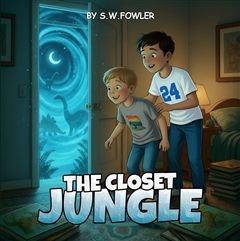
Adventure series with brothers, dinosaurs or hidden worlds are popular choices at this stage. If your family enjoys that kind of story, The Closet Jungle is an example aimed at readers around ages 6 to 10.
Frequently asked questions
At what age should a child read chapter books?
Many children start between six and eight, but there is no deadline. Listening to chapter books as read-alouds counts as valuable practice at any age.
Should I worry if my child still prefers picture books?
No. Picture books are rich and varied. Gently offer chapter books as well, but let preference guide you.
How do I know a book is the right level?
Use the page test: if your child can read most of a page smoothly and understands what happened, it is a good fit. If they struggle with many words, make it a read-aloud.
Are graphic novels okay?
Yes. They build comprehension and enjoyment, and many children move on to prose books after loving them.
How many minutes should chapter-book reading take each day?
Short and regular is best. Our article on daily reading time for a 7-year-old offers a realistic range.