Teacher and Classroom Guide
This guide is for teachers, librarians and homeschooling parents who want to share The Closet Jungle, or any adventure chapter book, with a group of children. It is built around themes, not page numbers, so you can use it with whichever chapter you are on. It is free to use for classroom and homeschool purposes.
About the book
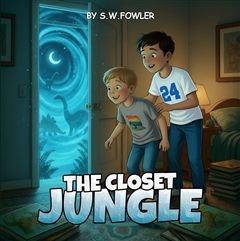
The Closet Jungle by S.W. Fowler follows brothers Reid and Josh, who find a dinosaur world behind their bedroom closet door. They rescue a baby Maiasaura and look after Luna, a glowing baby Parasaurolophus. The story is a good fit for read-alouds because it mixes humour and suspense with real questions about courage, teamwork and kindness. For a fuller overview see Behind the Book.
Suggested grade levels
- Kindergarten to Grade 1 (ages 5 to 7): teacher read-aloud, a few pages at a time, with lots of talk and drawing.
- Grades 2 to 3 (ages 7 to 9): shared reading, where children take turns reading a paragraph and the teacher reads the rest.
- Grades 4 to 5 (ages 9 to 11): independent reading with discussion circles and written responses.
These are suggestions, not a rating. You know your students best. We do not claim alignment to any specific curriculum standard; the activities support general reading, speaking-and-listening, writing and social-emotional goals.
A simple read-aloud routine
- Before reading (2 minutes). Recap: “What happened last time?” Predict: “What do you think the brothers will find?”
- During reading (10 to 15 minutes). Pause once or twice to ask a question. Keep the story moving.
- After reading (5 minutes). Choose one question from the lists below. Ask children to turn and talk to a partner before sharing with the group.
Discussion questions by theme
Curiosity
- Why do you think the brothers opened the closet door? Would you have?
- What is something you are curious about right now? How could you find out more?
- When is curiosity helpful, and when should we stop and ask a grown-up?
Courage
- Can someone be brave and scared at the same time? What does that look like?
- What helped Reid and Josh keep going when things were hard?
- Tell about a time you did something brave, big or small.
Teamwork and sibling bonds
- How are Reid and Josh different? How do those differences help them?
- Describe a moment when working together solved a problem that one person could not solve alone.
- What is something you are good at that could help a team?
Empathy
- How do you think the baby dinosaurs feel when they are far from their families?
- What can we do to make someone who is scared feel safe?
- How do you know when a friend or sibling needs help?
Responsibility
- What does it mean to take care of someone smaller than you?
- What are the boys responsible for? What happens if they do not do it?
- What are you responsible for at home or at school?
Vocabulary list
These words are useful for any dinosaur-adventure unit. Ask children to use each word in a sentence or draw it.
- Portal: a doorway to somewhere else.
- Prehistoric: from the time before people wrote down history.
- Dinosaur: a group of reptile-like animals that lived millions of years ago.
- Fossil: the preserved remains or print of a living thing from long ago.
- Extinct: no longer living anywhere on Earth.
- Herbivore: an animal that eats plants.
- Carnivore: an animal that eats meat.
- Habitat: the natural home of an animal.
- Crest: a bony or fleshy ridge on an animal’s head.
- Curious: eager to learn or to know.
- Courage: doing something even though you feel afraid.
- Responsibility: a duty to take care of something or someone.
- Empathy: understanding and caring about how someone else feels.
- Teamwork: people working together toward a goal.
Classroom activities: empathy and teamwork
1. The care plan (empathy and responsibility)
Ask small groups to write a “care plan” for a baby dinosaur that has lost its family: what does it need to eat, where should it sleep, what could scare it, and how can we comfort it? Groups share their plans and notice how many different kinds of care they thought of.
2. Brothers’ challenge (teamwork)
Give pairs a task that works best with two different strengths, such as building a tower from paper and tape where one partner plans and the other builds. Afterwards ask: what did each person bring? What would have been harder alone?
3. Perspective circle (empathy)
Choose a tense scene and have children share how each character might feel, using the sentence starter “If I were ___, I might feel ___ because ___.”
4. The closet door writing prompt (imagination)
Say, “You open your classroom cupboard and find a different world. What is it?” Give 10 to 15 minutes for a drawing and a few sentences, then let volunteers share.
5. Fossil dig and field notes (science)
Bury plastic bones or shells in trays of sand. Children excavate, sketch and describe what they find, noticing size, shape and texture. Connect to our activity ideas.
6. Real-or-pretend (critical thinking)
List facts from the story and sort them into “could be real” and “imagined”. Then check the real ones with a book or museum website, a good habit of mind for scientists and readers.
Differentiation
- Younger or emerging readers: read aloud, use picture responses, and let children answer by acting or pointing.
- Multilingual learners: pre-teach the vocabulary with pictures and let children discuss first in their home language.
- Advanced readers: ask them to compare the book to a non-fiction dinosaur book and write what is accurate and what is invented.
- Children who find group talk hard: offer a written or drawn response and a partner instead of whole-class sharing.
Homeschool tips
Read one short chapter a day, pick one question, and add one activity per week. Keep a simple notebook where your child draws a scene and writes a sentence after each reading. Our article on daily reading time may help you plan.
Author visits and questions
Would you like to ask the author a question or explore a school or library visit? Please contact us.
Please note: this guide is for adults. It is intended to support teaching and does not replace your professional judgement or school policies.